


People ask why I don't use AI to write my essays.
The question usually comes with an assumption baked in: that writing is a means to an end. That the goal is the published artifact. That anything which produces that artifact faster is obviously better.
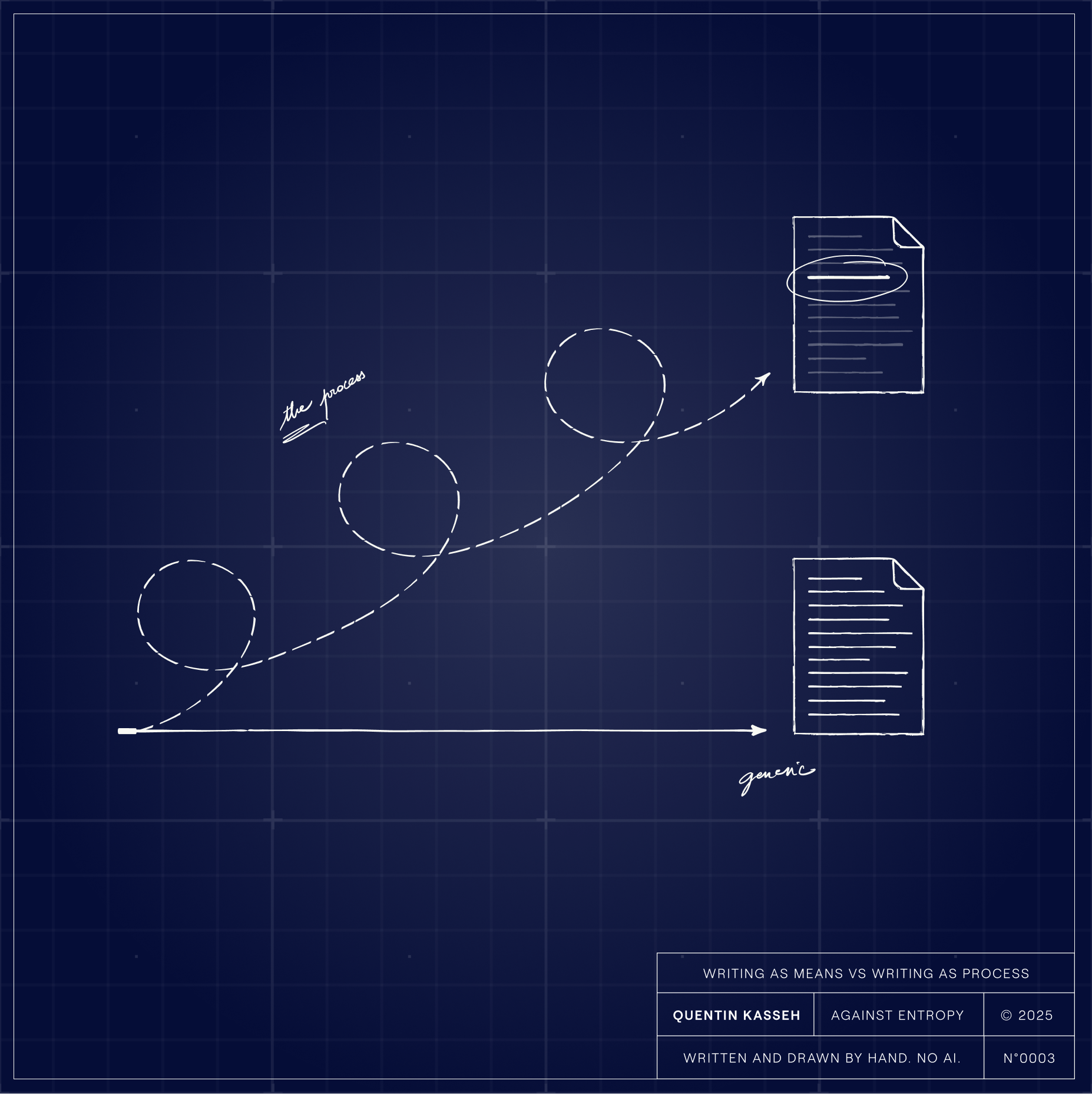
I understand the logic. I reject the premise.
What AI and Tools I Use
Let me be specific about what I do and don't use.
I use Grammarly. It catches typos, helps me flag passive voice, and gives me comfort that I'm writing proper English (English is my 3rd language). This is mechanical.
I use xAI (Grok) for research, for exploring ideas and for pressure-testing arguments. I'll ask questions, research certain topics, etc. This is conversation similar to what I'd do with a knowledgeable colleague if one happened to be sitting next to me.
What I don't do is ask AI to write my essays.
It's a choice about what writing is for.
Why I Create My Own Illustrations
The same principle applies to visuals and illustrations.
Every diagram, illustration, and visual in my deep dives and technical essays is created by me with support from my team (shoutout to Catalina!). We don't use Midjourney. We don't use Nano Banana. We don't prompt image generators.
This may surprise you as AI image generation is fast and certainly much cheaper. It produces visuals that look polished enough for a blog post. Why spend hours on custom illustrations when you could generate something "good enough" in seconds?
Because "good enough" isn't the point.
And because visuals do something words cannot.
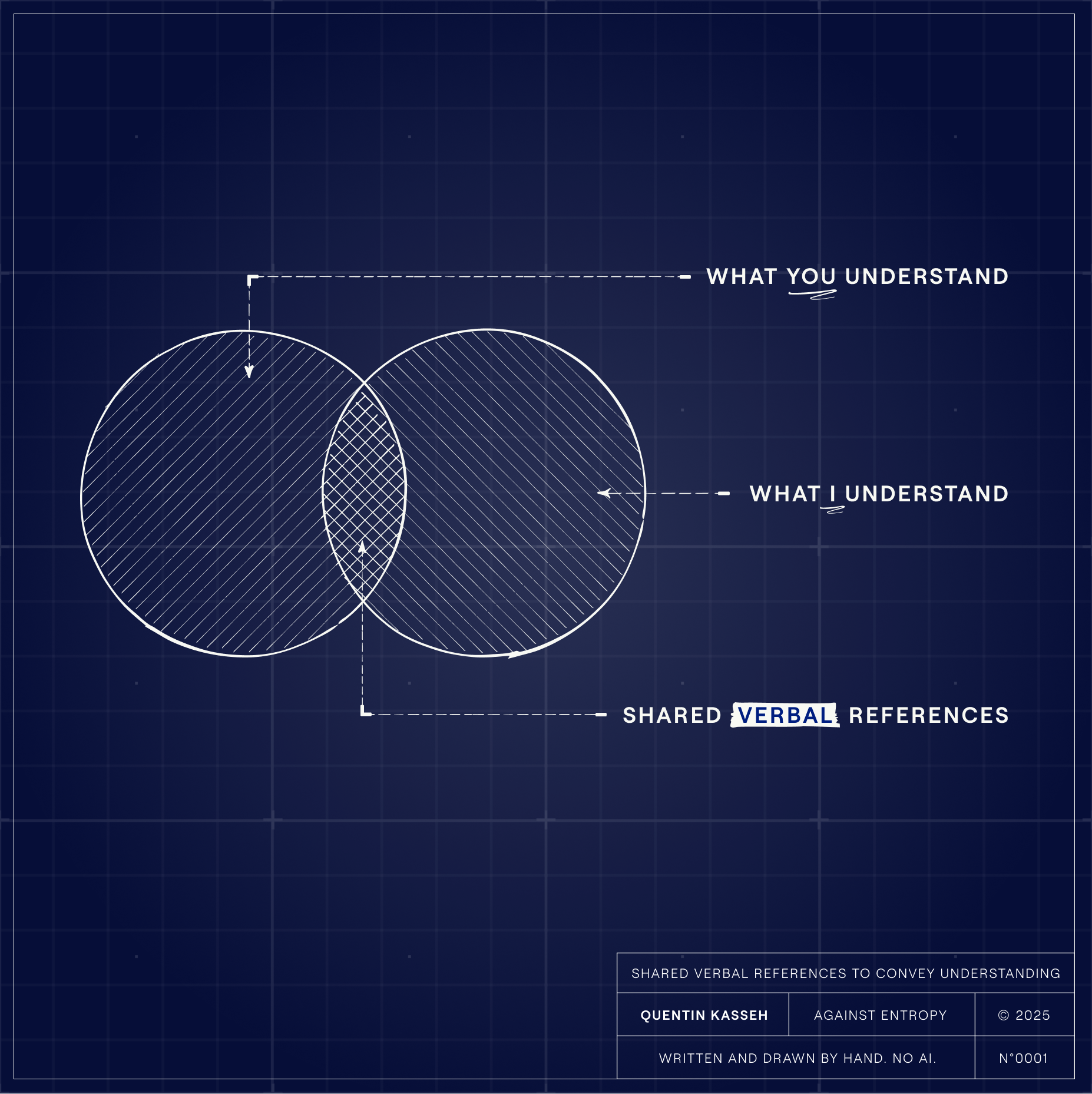
Think about shared references. When I write a sentence, you and I need to share verbal references for it to land. We need overlapping vocabulary and that overlap is often small.
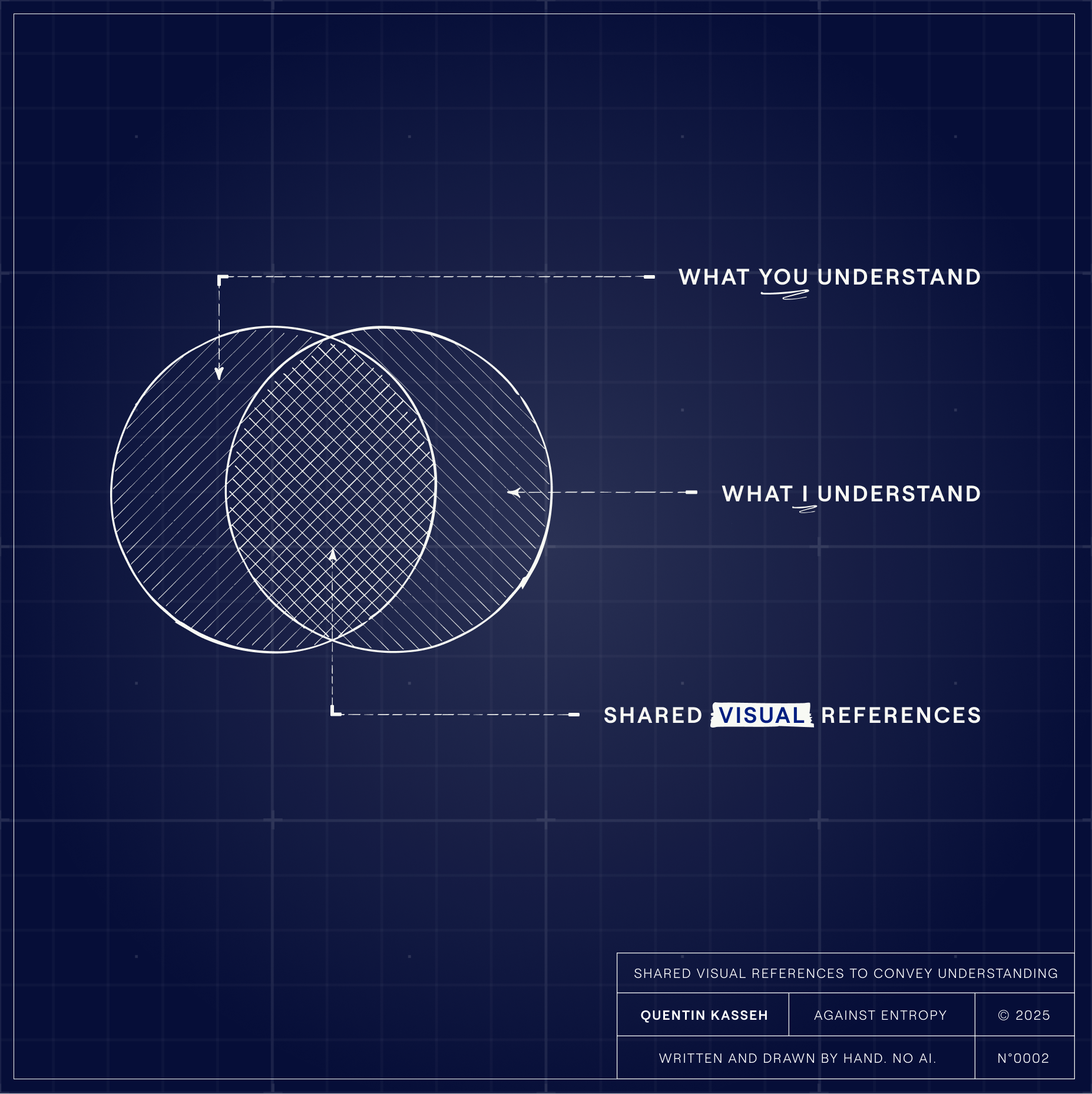
Visual references work differently. The overlap is larger. A well-made diagram creates shared understanding faster and more completely than paragraphs of explanation. It compresses complexity into something you can see all at once.
This is why illustrations aren't decoration. They're a second channel of meaning.
These decisions are part of my creative work. They clarify my own understanding. They shape how the reader will face the concepts. A generated image hardly does that. And our eyes would glance at it and quickly know it's generated and completely miss the core of the message.
My illustrations are mine. They encode a specific perspective on the problem. That specificity is the value.
Martin Scorsese: "The Most Personal Is the Most Creative"
This maps to something Scorsese said that I keep coming back to:
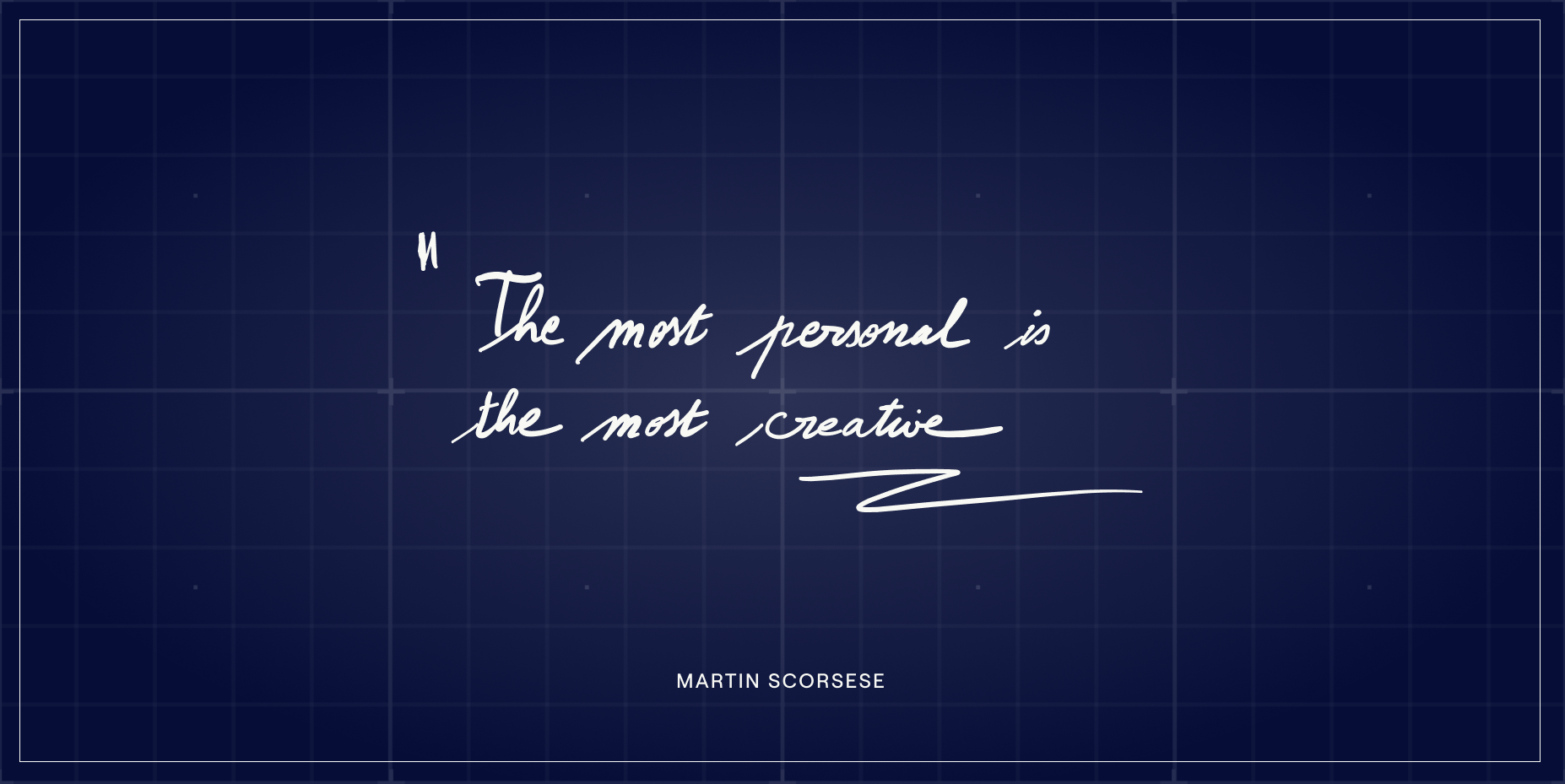
He was talking about film. But the principle applies to any creative work, including the kind of technical writing I do here.
"That quote was from our great Martin Scorsese."
— ABC News (@ABC) February 10, 2020
In a heartwarming moment, Bong Joon-ho recognizes Martin Scorsese after winning the Oscar for Best Directing—and the crowd gives Scorsese a standing ovation. https://t.co/8kz7m5vtnF #Oscars pic.twitter.com/s4mOuwPKBQ
You'd think creativity means inventing something nobody has seen before. Something universal. Something that transcends the individual. But Scorsese argues the opposite. The more specific you get, the more you draw from your own particular experience and perspective, the more creative the work becomes.
When I write about something like semantic drift I'm drawing on my persoal experience and years watching and building data systems. On specific conversations with engineers and execs who didn't understand what I was telling them. On the particular frustration of seeing the same problem ignored across several teams. On my time at RelationalAI, where I saw what's possible when you treat knowledge representation seriously.
That specificity is the work. Strip it out, and you're left with a nicely written summary. Accurate, perhaps. But not creative. Not personal. Not mine.
What LLMs Actually Do
Here's what most genAI users miss (though most know it): large language models are trained on averages.
LLMs learn statistical patterns across enormous data sets (organic and synthetic). They predict the most likely next token given what came before. When they generate text, they're producing something that resembles the aggregate of what they've seen. That's how it works at its core.
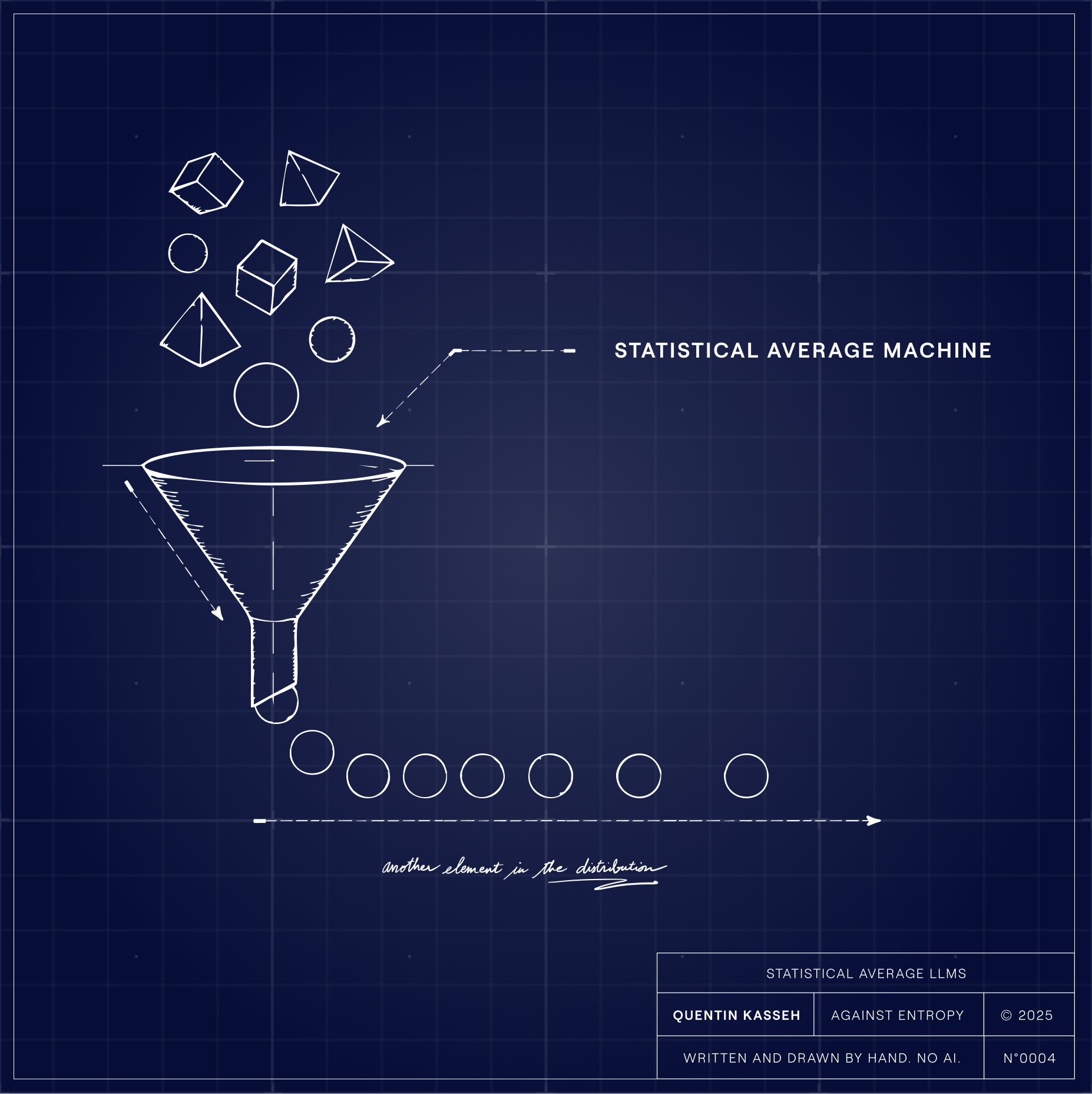
The result is usually "good" writing: it hits the expected beats, it uses the vocabulary that typically appears whatever topic it covers. But it lacks the specific gravity of a particular mind working through a particular problem.
I've read AI-generated essays about data engineering. They're fine. They cover the topics. They use the right terminology. They could pass an exam. But they don't surprise me. They don't reveal a point of view of a person. They don't make me feel like I'm in conversation with someone who has struggled with these problems and formed a personal opinion.
They're averaging.
Writing Is Thinking
Here's what most people get wrong about technical writing: they think it's communication. You have ideas in your head, you translate them into words, the reader receives the ideas. Writing as transmission. Like writing the documentation of your SaaS.
Writing is thinking. The essay doesn't exist before I write it. I don't have a fully formed argument that I then transcribe. I have intuitions, fragments, half-formed ideas. The act of writing is the act of discovering what I actually believe.
When I wrote about semantic drift, I didn't start knowing that the distinction between syntactic and semantic problems was the key frame.. I felt it should be, but I didn't fully believe it. I started with my frustration: something is broken in how we handle data quality, and nobody is talking about it in a way that's pragamtic without a sales pitch behind it.
The writing process forced a different framing. I had to choose words and a certain structure. Each choice constrained the next. By the end, I had an argument I couldn't have articulated at the beginning.
There's a quote by Cicero:
"If I had more time, I would have written a shorter letter"
Most people read this as a joke about but it's really about distillation.
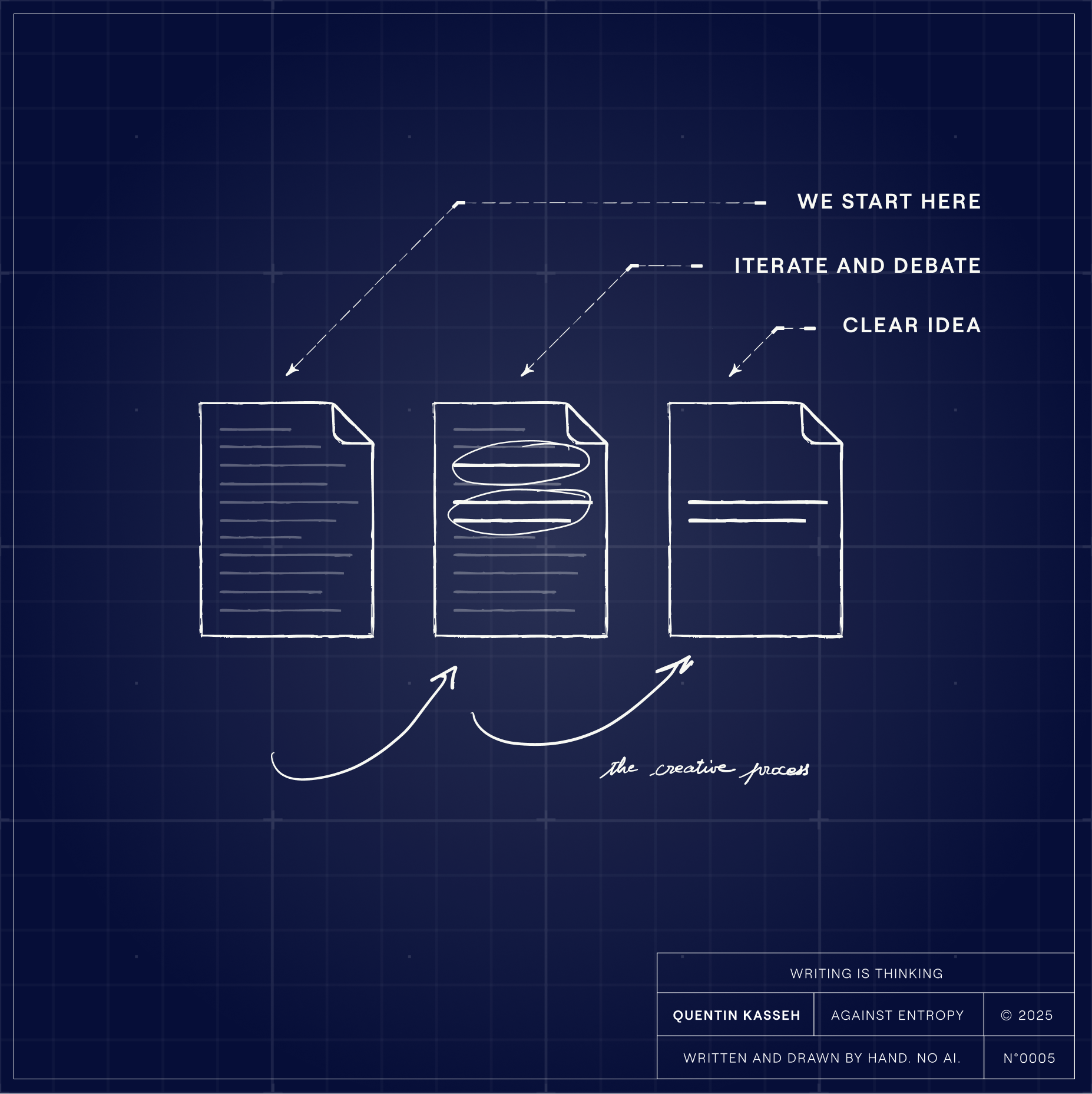
The first draft is always long. It contains everything: the good ideas, the bad ideas, the tangents. The work is cutting and finding the core. Removing everything that doesn't serve the argument. This takes time. It takes judgment. It takes knowing what you're trying to say, which you only discover by writing it badly first.
AI can generate a first draft instantly. What it cannot do is distill. It doesn't know what matters to you because it doesn't have your point of view.
This is creative work. Not like in the sense of fiction or poetry (though it shares more with those than most technical writers admit), but in the sense that something new comes into existence through the process. The output is not a rearrangement of existing pieces. It's a synthesis that didn't exist before.
If I outsource that process, I don't get my thinking. I get the median result that may read better. But, I lose the thing that makes the work worth doing.
Engineers Are Artists
I've written before that engineers are artists and they don't even realize it (in "The Work" section here). We compose systems the same way artists arrange and compose sound. We make choices about elegance, tension, resolution. The code has rhythm and the architectures have a point of view, even a personality.
The same applies to technical writing. When I'm structuring an essay, I'm making aesthetic choices. Where do I put the turn? Which metaphor will make the abstract concrete? How do I earn the reader's attention for another paragraph?
I write to discover what I think. I write because the discipline of putting words on screen (or sometimes paper) forces a clarity of thinking. It also helps me convey it to others (colleagues, clients, friends). These are personal acts. Outsourcing them defeats the purpose.
Will AI Get Better?
I want to be honest about uncertainty. LLMs in 2025 will not be the LLMs of 2030 As I'm writing this, OpenAI's Chatgpt turned 3 years old, and in just 3 years the industry saw tremendous progress.
The architecture might evolve. The training approaches might change. We most likely will develop models that do more. But how and to what extent?
What I know is that today, the tools produce competent mediocrity. They're useful for the mechanical parts of writing: grammar, consistency, catching errors. They're useful for research. They're not useful for the part that matters to me in this blog: the personal, specific, creative act of a particular mind working through a particular problem.
Maybe that changes. I'll pay attention. I'll experiment. I'm not dogmatic about the tools.
But I am dogmatic about the goal. The work I care about is work that could only come from me. My experience. My frustrations. My specific angle on problems I've lived with for years. If a tool helps me express that more clearly, I'll use it.
The Hard Path
There's a connection here to everything else I write about. Entropy is the tendency toward disorder, toward averaging, toward the loss of specific structure.
The easy path is to outsource the writing to AI. It's mcuh faster. It's definitely much cheaper. It produces something that looks professional. But it's also a surrender to averaging. You become one more voice in the statistical distribution, indistinguishable from the median. And fundamentally, the question I have for those who do: why do you even publish the content?
The hard path is to sit with the blank page (maybe with a coffee and a cigar too). To struggle through the unclear thinking until it becomes clear. To make choices that are yours, that reflect your particular experience, that could not have been produced by anyone else.
I choose the hard path not because I'm a purist. Not because I have something against efficiency. Because the hard path is the only one that produces work worth reading IMO.
Average writing produces average thinking. I'd rather struggle. And if it's average, at least I earned it.
A note on process: Every essay is written and edited by me. I may use AI to research a subject, explore a question, or pressure-test an argument, but not to supply the point of view or write the final prose. Illustrations are original and created with human collaborators.
