


Gartner just published their first-ever Magic Quadrant for Decision Intelligence Platforms, dated January 2026, with sixteen vendors evaluated across the full taxonomy: Leaders, Challengers, Visionaries, Niche Players. The full report is available from Gartner here.
I read it closely, both as someone who's been building in this space and as someone with a stake in where the category goes next. I was Director of Engineering at RelationalAI, one of the vendors evaluated in the report, and I've spent years working with knowledge graphs, declarative ontologies, and semantic reasoning. I now run Syntaxia, where we're building what I believe is the foundational layer this category will increasingly require.
This piece is my practitioner's read of the report: what it gets right, what it implies, and where I think the next iteration of the category will need to go.
Why This Category Matters
The shift from "data-driven" to "decision-centric" is one of the most important reframes the data industry has seen in a decade. Dave McComb, founder of Semantic Arts and author of Software Wasteland and The Data-Centric Revolution, has been arguing for years that most enterprise data problems stem from treating applications as primary and data as a byproduct. The DI framing takes a related but distinct step: instead of starting with data or applications, it starts with the decision itself, models it explicitly, and then asks what inputs, governance, and feedback loops are required to make it well. Both McComb's work and the DI category point in the same direction: the value lives in the meaning, and the architecture should reflect that.
The report projects that by 2028, a quarter of CDAO vision statements will have adopted this framing. That feels conservative to me. Once you start thinking in terms of decision flows rather than data flows, the organizational implications are enormous: who owns a decision, what qualifies as a valid input, how you audit the reasoning, how you learn from outcomes.
The platforms on this quadrant are building real capabilities around these questions. FICO, SAS, IBM, and Aera Technology are doing serious work in decision automation. Quantexa's contextual decision intelligence and ACTICO's governance for regulated industries represent genuinely differentiated approaches. The category deserves the momentum it's getting.
Graph and Knowledge Techniques: A Distinction Worth Drawing
One of the areas I found most interesting in the report is the inclusion of "graph and knowledge techniques" as a common feature. The description references ontologies, semantic networks, knowledge graphs, graph analytics, and causal graphs. This is significant because it signals that the analysts see knowledge representation as integral to decision intelligence, and they're right.
But the term "knowledge graph" covers a wide range of implementations, and the differences matter for decision quality. I've written about this distinction before: a knowledge graph is a commitment to formal meaning, not a technology choice. The implementation details matter less than whether the system can actually reason over what it stores.
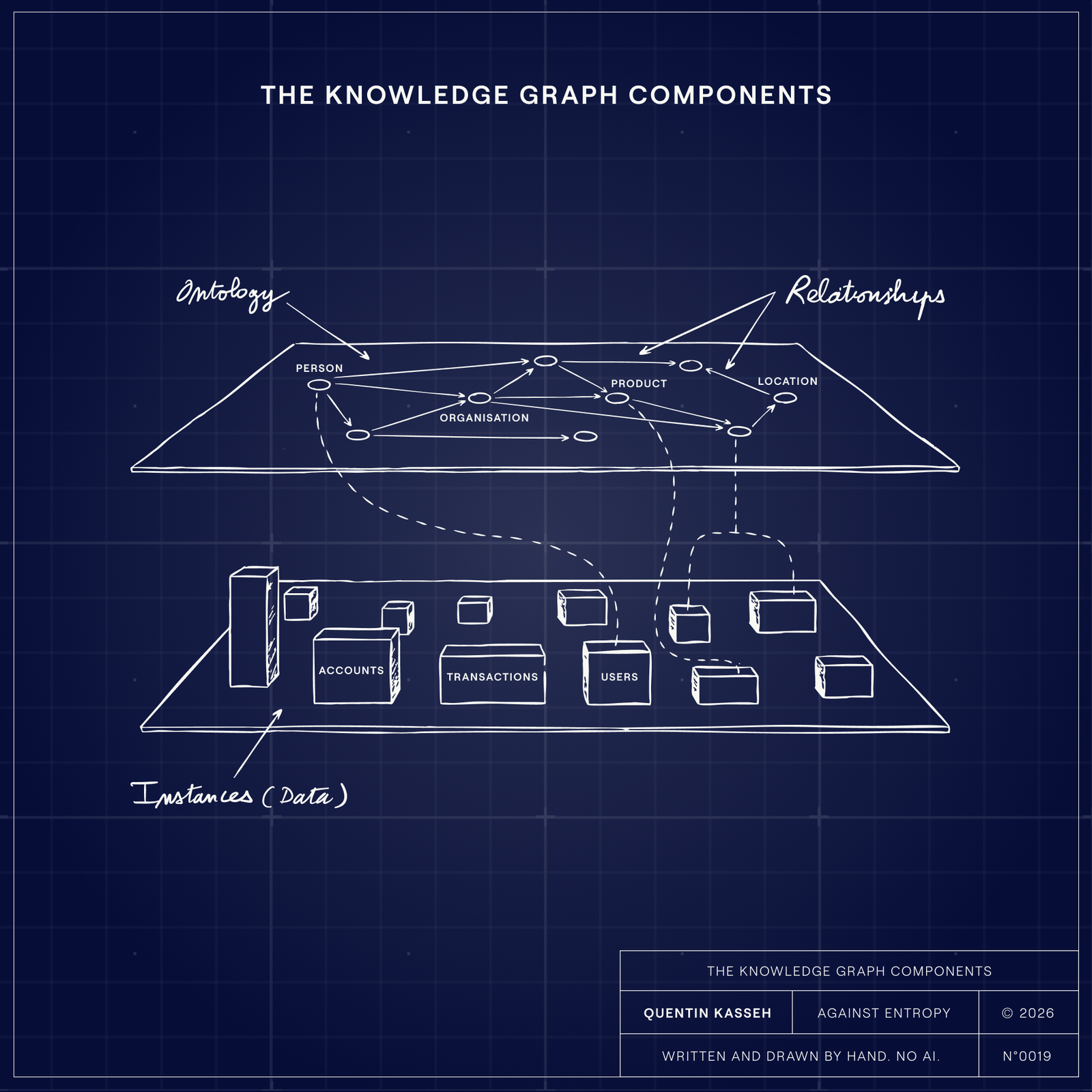
Most graph implementations in the DI space use labeled property graphs (LPGs). Neo4j is the most familiar example. An LPG stores entities as nodes and connections as edges, with properties on both. It's flexible, expressive, and easy to query. For many use cases, including fraud detection, entity resolution, and network analysis, an LPG is exactly the right tool.
Where the distinction becomes critical is at the conceptual layer above the graph. A formal ontology (built on OWL, RDF, SHACL, etc.) defines what things are, what relationships mean, and what constraints must hold. It carries semantics that a machine can reason over. A reasoner operating on a formal ontology can derive new facts from existing ones and detect when stated facts violate the model.
An LPG, by contrast, stores structure without encoding meaning. You can build ontological-looking data in nodes and edges, give them rich labels, and create beautiful visualizations. The graph connects things. Whether those connections carry verifiable, enforceable meaning depends entirely on what sits above it.
I raise this because the report evaluates vendors on their use of graph and knowledge techniques, and I think the next iteration of the evaluation could benefit from distinguishing between graph-as-storage and graph-as-knowledge. The decision quality implications are different. When a DI platform reasons over formally defined business concepts, it can enforce consistency and detect violations. When it queries a property graph, it retrieves connected data, which is valuable but carries different guarantees about semantic reliability.
Temporal Awareness
The report identifies decision governance as a mandatory feature, and rightly so. As decisions become more automated, organizations need auditable guardrails, explainability, and compliance. The vendors that invest in governance will lead in regulated and high-risk environments.
I'd extend this argument one step further: governance of decisions requires governance of meaning over time.
Consider a decision model that triggers spend allocation based on customer_lifetime_value. That metric is a composite of several upstream calculations: average order value, purchase frequency, churn probability, discount adjustments. Each of those components has a definition, and those definitions change. A product team recalibrates churn probability to exclude trial users. Finance adjusts the discount normalization logic after a pricing restructure. Marketing redefines the attribution window for first-purchase events.
Each change is locally reasonable. Each is made by a competent team within their domain. And each subtly shifts the composite metric that the decision model depends on.
A fully governed decision platform will log the trigger event, record the recommendation, and produce a perfect audit trail. What it may not capture is that the meaning of the input metric has drifted from what the model was calibrated against.
Temporal awareness addresses this. It means versioning the definitions themselves: when did the meaning of "customer lifetime value" change, who authorized the change, what downstream models depend on it, and whether those models have been recalibrated to reflect the new semantics. This is the connective tissue between decision governance (which the report covers well) and semantic governance (which I believe becomes increasingly essential as automation scales).
Some vendors on the quadrant are building pieces of this. The ones working with formal knowledge representations have a natural advantage here, because ontologies are inherently versionable, and changes to a formal model propagate in ways that changes to a column comment or a wiki page simply cannot.
Vertical Strategy and the Architecture of Meaning
One of the evaluation criteria that stood out to me is vertical/industry strategy. The report is explicit: vendors that go deep in specific verticals, with domain-specific templates, partnerships, and compliance workflows, score higher on this axis. Vendors with broad, undifferentiated approaches get cautioned.
This resonated because it validates something I've come to believe from building in this space: meaning is specific before it's general.
"Customer" in a GTM context carries different semantic weight than "customer" in a supply chain context. The relationships, constraints, lifecycle stages, and governance requirements are all different. An ontology that tries to define "customer" universally, across every vertical simultaneously, produces something so abstract it's useless. An ontology that defines "customer" precisely within a go-to-market workflow, with explicit relationships to pipeline stage, account hierarchy, contract terms, and engagement signals, produces something teams can actually build on.
This is why the vertical-first approach to building semantic infrastructure makes sense architecturally, and why the report's emphasis on vertical strategy matters beyond just market positioning. The vendors that win in decision intelligence will be the ones that encode domain-specific meaning with enough precision that both humans and AI agents can reason over it reliably. That precision comes from going deep, then expanding.
At Syntaxia, this is exactly the path we're on. Our purpose is to turn the chaos of data into the clarity of meaning. Our tagline is "the operating system for business meaning". And our approach is to build that operating system one vertical at a time, starting with go-to-market data, where the fragmentation of CRMs, marketing automation, enrichment tools, and email systems creates exactly the kind of semantic chaos that corrupts decisions.
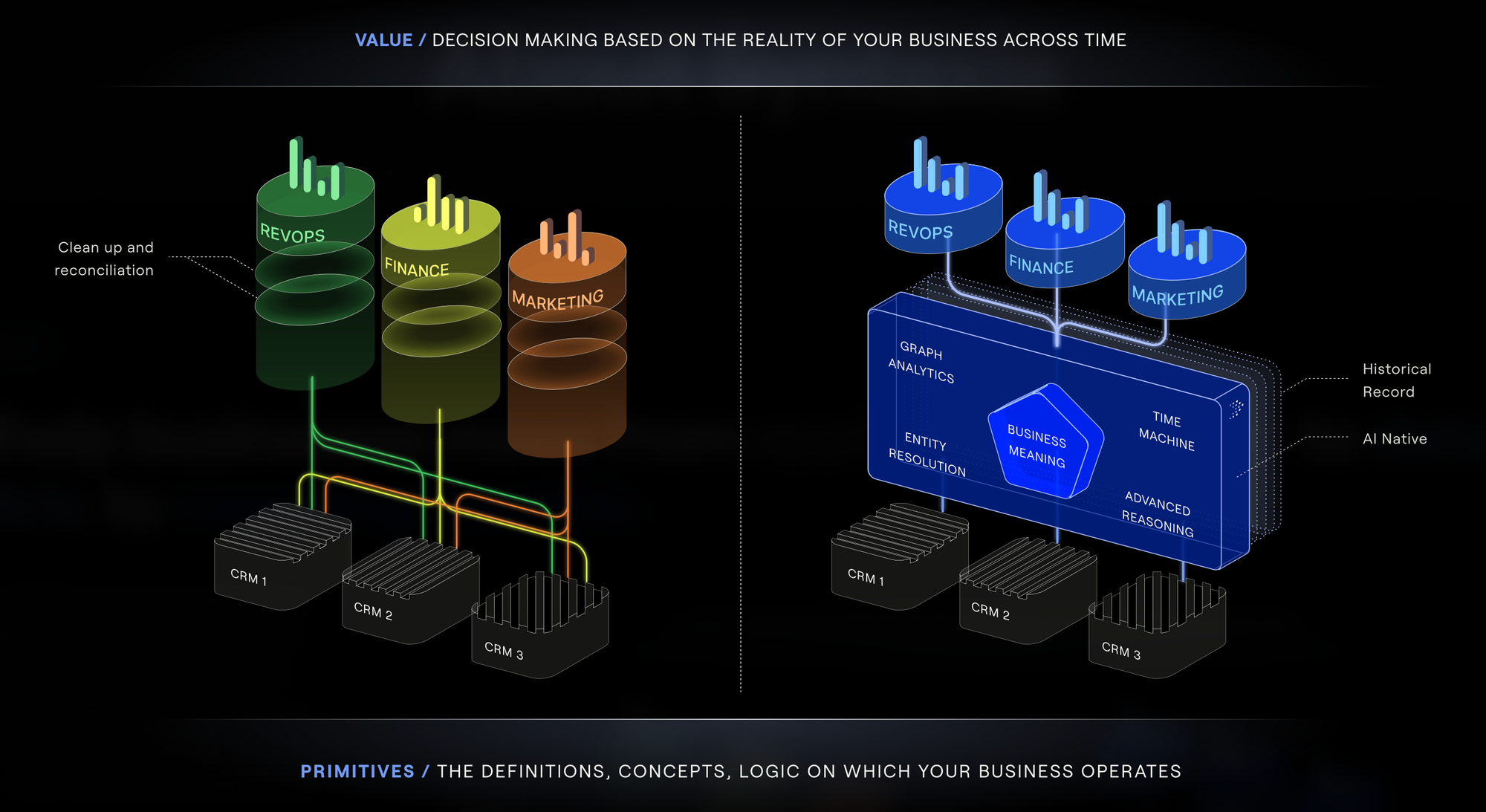
We chose GTM first because the pain is acute and the feedback loops are fast. Sales teams that operate on unified, semantically governed data can tell you within a quarter whether the truth they're acting on is actually true. That tight feedback loop lets us refine the ontology, prove the value, and expand into adjacent verticals with a foundation that has been tested in production.
The long-term architecture is the full operating system. The adoption path is one vertical at a time.
What Comes Next
The first Magic Quadrant for Decision Intelligence Platforms is a milestone for the category. It gives enterprises a framework for evaluating vendors, gives vendors a benchmark for differentiation, and gives the broader industry a shared vocabulary for what decision-centric architecture actually means.
My read, as someone building in this space, is that the category's next evolution will involve a deeper reckoning with the semantic layer underneath the decision layer. The platforms that model decisions well will increasingly need to verify that the meaning of their inputs is stable, governed, and traceable over time. The platforms that support graph and knowledge techniques will face pressure to clarify what kind of knowledge their graphs actually encode. And the platforms that go deep in specific verticals will have an advantage, because domain-specific meaning is where decision quality lives.
The report's own framework already points in this direction. The evaluation criteria for innovation, governance, and vertical strategy all reward the kind of semantic depth that formal ontologies and knowledge graphs make possible. The vendors and builders who take this seriously, who invest in meaning as a first-class architectural concern, will define the next iteration of this category.
The decisions are only as good as the meaning underneath them. That meaning deserves the same rigor we give to the decisions themselves.
This is the kind of analysis I publish. If you're building in the decision intelligence space and want practical frameworks grounded in production experience, subscribe below.
Every essay is written and edited by me. I may use AI to research a subject, explore a question, or pressure-test an argument, but not to supply the point of view or write the final prose. Illustrations are original and created with human collaborators.
If you want to know why, or how these essays come together, here's the process.

